How Does Stress Impact Hormone Levels?
When women come to me for support with their hormones, one of the most common things I notice is that they are under far more stress than they realize.
Of course, there are the obvious sources of stress: relationships, work, finances, family responsibilities. But what many women don’t realize is that stress on the body can come from many different places, and all of these stressors can influence hormone health.
Things like:
Skipping meals
Poor sleep
Rushing and multitasking all day
Overtraining or pushing through exhaustion
Chronic mental stress
Toxin exposure from everyday products
Perfectionism and high-achiever pressure
All of these can place a significant stress load on the body. And when that stress load becomes chronic, it can begin to impact hormone levels in powerful ways.
Your Body Is Not Working Against You
One of the first things I tell women is this:
Your body is beautiful and it is always working in your favor.
Your body is constantly trying to keep you safe and alive.
The challenge is that your nervous system cannot distinguish between different types of stress.
To your body, these situations can look very similar:
Rushing out the door because you’re running late
A high-intensity workout when you're already exhausted
Fasting until noon or forgetting to eat lunch
Multitasking and feeling overwhelmed
Financial pressure or relationship stress
Running from a tiger or bear
Biologically, the body interprets all of these as potential threats.
When this happens, your nervous system activates the stress response, also known as fight, flight, freeze, or fawn.
This is an incredibly intelligent survival mechanism designed to protect you.
But here’s the problem.
This system was designed to turn on occasionally, not constantly.
In modern life, many women are activating this stress response all day long.
And when the body is stuck in that state, it begins to affect hormone function.
How Stress Affects Hormones in the Body
Later in my own health journey, when I began studying women’s health and hormones more deeply, one concept completely illuminated everything for me: the hormone hierarchy.
The hormone hierarchy explains that certain hormones take priority in the body.
At the foundation of that hierarchy is cortisol, the primary stress hormone.
When your body perceives stress, cortisol rises to help you deal with the perceived threat.
From the body’s perspective, survival comes first.
So while cortisol is elevated, the body may temporarily deprioritize other processes such as:
Deep restorative sleep
Balanced metabolism and weight regulation
Fertility and ovulation
Stable energy levels
Healthy digestion
Optimal thyroid function
From a survival standpoint, these functions are considered luxuries, not immediate necessities.
This is why chronic stress can ripple into many different hormone-related symptoms.
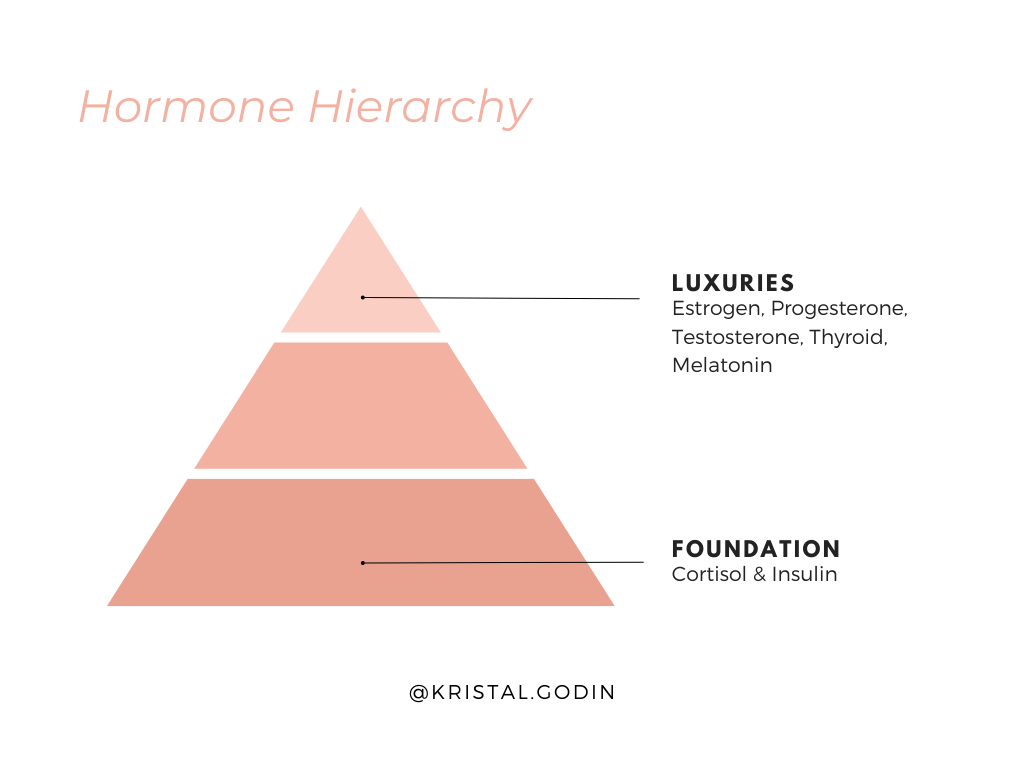
When we understand the Hormone Hierarchy and how to regulate cortisol and insulin, we can create a solid foundation for our body to feel safe enough to carry out “luxury” functions.
The Symptoms I Commonly See
In the women I work with, chronic stress often shows up in ways that aren’t always immediately recognized as hormone-related.
Some of the most common symptoms include:
Persistent fatigue
Brain fog or difficulty concentrating
Intense cravings (especially sugar)
Afternoon energy crashes
Irregular menstrual cycles
Unexplained or stubborn weight gain
Many women feel frustrated because they are trying to “fix their hormones,” but they are unknowingly living in a state where the body is constantly being pushed into stress mode.
My Own Wake-Up Call About Stress
My alarm would go off at 6 a.m., and I’d hit snooze a few times before rushing to get out the door by 6:30. That meant using dry shampoo, skipping breakfast and surviving on caffeine all morning.
At the time, I was working as a teacher. I truly loved my students and teaching them but my workload as an English as a Second Language specialist was incredibly heavy.
My days were full and demanding. I was often teaching 20 or more different groups of students each week, traveling between two or three different schools, sometimes even during my lunch break.
I taught multiple grade levels (which meant lots and lots of planning), from grades 1 to 6 and some groups were specifically for students with special needs or others for behavioral challenges… again, that meant lots more planning (and we won't get started on the amount of correcting or report cards involved with 350+ students).
There was one year I had been given multiple groups of students with behavioral challenges. Their cases were so severe they weren't integrated with the regular students, and it wasn’t uncommon for a student to become angry or overwhelmed, throw furniture, or become physically aggressive in these classes. Sometimes we even had to evacuate the classroom for safety.
Their homeroom teacher had a specialized university degree preparing them to teach these students who has special needs. Mine did not. And when I voiced my concern to my union, I was told there was nothing they could do. When I asked for support from my school service center, I was sent in circles.
Looking back now, it’s no surprise that my nervous system was completely frazzled.
Around that time, I was also experiencing chronic fatigue, brain fog, digestive issues and difficulty losing weight. That was when I started getting my thyroid tested. My TSH levels came back slightly elevated, but not high enough to be considered hypothyroidism. I was labeled as having subclinical hypothyroidism, which my doctor considered “normal enough.”
But I didn’t feel normal.
I remember just pushing through and hoping things would eventually get better. I had bills to pay and felt like I had no choice but to just keep going.
At that point, I didn’t yet understand how stress affects hormones in the body. I didn’t realize that skipping breakfast, running on coffee, squeezing in high-intensity workouts because I thought that was what I should be doing, and rushing through not only my mornings but my days from one class to the next juggling photocopies, lesson plans, corrections, emails, supervision, and living in a constant state of pressure were all signals to my body that it needed to stay in survival mode.
Around that time, I somehow found myself enrolling in a yoga teacher training in 2017. To this day, I still can’t fully explain how I ended up there, but looking back now, I believe my body knew I needed nervous system support.
Even then, things didn’t change overnight because there were still other sources of stress I hadn’t yet recognized.
For example, I had no idea that many of the products I was using daily could contribute to my body’s overall stress load. Like many people, I assumed that if something was sold in stores, it must be safe.
I was using aerosol dry shampoo almost every day when I didn’t have time to wash my hair, deodorant containing aluminum, toothpaste with fluoride and non-organic cotton tampons. These were products I used without ever questioning them.
It wasn’t until much later, when I began studying women’s health and hormones more deeply, that all the puzzle pieces finally started coming together.
The concept that illuminated everything for me was the hormone hierarchy.
When I learned that cortisol, our primary stress hormone, forms the foundation of the hormone hierarchy, everything suddenly made sense.
Looking back now, I can see that my body wasn’t failing me, it was doing everything it could to keep me going through a very stressful chapter of my life. And once I understood how stress affects hormones, the symptoms I had been experiencing for years finally started to make sense.
This realization became the foundation of the work I do today, helping women understand how stress impacts hormone levels and how to support their bodies in a more compassionate and sustainable way.
Where to Start if Stress Is Affecting Your Hormones

When a woman realizes that stress and lifestyle factors may be affecting her hormones, I always come back to these foundational practices: stabilizing blood sugar, nervous system regulation, prioritizing sleep and menstrual cycle tracking.
The good news is that supporting your hormones doesn’t require perfection.
It begins with strengthening the foundations.
Here are some of the first places I often encourage women to start.
1. Stabilize Blood Sugar
Blood sugar stability is one of the fastest ways to reduce stress signals in the body.
Balanced meals that include protein, fiber, and healthy fats help prevent blood sugar spikes and crashes, which can otherwise trigger cortisol release.
2. Support Your Nervous System
Since cortisol sits at the foundation of the hormone hierarchy, nervous system regulation is essential.
Practices like:
gentle yoga
breathwork
slowing down daily routines
spending time in nature
mindfulness practices
can help shift the body out of chronic fight-or-flight and into a more restorative state.
3. Prioritize Sleep
Sleep plays a direct role in regulating both blood sugar and cortisol.
Consistent sleep routines, reducing evening stimulation, and allowing the body enough time to truly rest can make a significant difference in hormone health.
4. Track Your Menstrual Cycle
Menstrual cycle tracking is one of the most powerful tools for understanding your body.
We know that the body is often more sensitive to stress during the luteal phase (the phase before your period).
By tracking your cycle, you can support your body by:
choosing less intense workouts during this phase
scheduling more rest days
giving yourself more space and gentleness
Instead of pushing against your biology, you begin working with your body’s natural rhythms.
A More Compassionate Way to Support Your Hormones
Hormone health is not about doing everything perfectly.
It’s about understanding how the body works and learning how to support it with compassion.
Your body is not broken.
It is constantly adapting, protecting you, and trying to keep you safe.
When we begin to reduce the body’s stress load and strengthen the foundations of health, hormones often begin to shift naturally.
And that’s where true healing begins.
Your Next Step for Supporting Your Hormones
If this article resonated with you and you’d like to understand more about how stress and blood sugar influence your hormones, I’ve created a free workshop inside the Happy Hormone Collective called Hormone Foundations.
In this workshop, I explain the concept of the hormone hierarchy, including why stabilizing blood sugar and supporting cortisol are often some of the most powerful first steps for improving hormonal health.
Inside the Collective, you’ll also find hormone education, supportive practices, and a community of women learning how to reconnect with their bodies and support their hormones in a sustainable way.
You can learn more and join the Collective here.
Because when women have the right knowledge and support, everything can begin to shift.
It’s time to RISE into your most vibrant mind, body & spirit.

The Happy Hormone Collective is made up of women who are mostly in their 30’s and 40’s.
A Gentle Reminder
Your body is always speaking to you.
Real self-care is learning how to listen.
I am honoring you, wherever you are on your journey.
With love,
Kristal
